Massachusetts Notary Solutions for Middlesex & Greater Boston Areas

Does a Power of Attorney Always Need to Be Notarized?
Learn whether a Power of Attorney must be notarized in Massachusetts, when notarization is required, common misconceptions, and how to make sure your POA is valid.
12/16/20253 min read
Does a Power of Attorney Always Need to Be Notarized?
A Power of Attorney is not always required to be notarized in Massachusetts, but in practice, most Powers of Attorney are notarized because institutions and third parties typically require it. Whether notarization is legally required depends on how the document will be used and who is relying on it.
People ask this question because a Power of Attorney is a powerful document. It authorizes one person to act on another's behalf in legal, financial, or medical matters. Because of the authority involved, many people assume notarization is always mandatory. The reality is more nuanced.
What Massachusetts Law Says About Power of Attorney
Under Massachusetts law, a Power of Attorney must be signed by the principal, the person granting authority. For many types of Powers of Attorney, including general and durable Powers of Attorney, notarization is not required by statute to create the document.
However, Massachusetts law requires notarization if the Power of Attorney will be used to conduct real estate transactions or recorded with a registry of deeds. In those cases, notarization is mandatory for the document to be accepted.
Even when notarization is not strictly required by law, it is strongly recommended, as many institutions will not honor an unsigned or unnotarized Power of Attorney.
Why Most Powers of Attorney Are Notarized Anyway
Banks, financial institutions, title companies, and government agencies almost always require a notarized Power of Attorney. Notarization ensures that the principal signed the document voluntarily and was identified correctly.
Without notarization, institutions may question authenticity, refuse access, or demand additional documentation. This often leads to delays or the need to redo the document under time pressure.
Notarization also helps prevent fraud. Because a Power of Attorney grants significant authority, notarization adds a layer of verification that protects all parties involved.
Witnesses Versus Notarization
Some people confuse witnessing with notarization. Witnesses and notaries serve different purposes. Witnesses observe the signing but do not verify identity to the same legal standard as a notary.
In Massachusetts, certain Powers of Attorney may require witnesses depending on the document type or issuing authority. However, witnesses do not replace notarization when notarization is required by law or by a third party.
Many professionally prepared Powers of Attorney include both witnesses and notarization to maximize acceptance.
Common Misconceptions About Power of Attorney Notarization
A common misconception is that notarization makes a Power of Attorney permanent or unchangeable. In reality, the principal can revoke a Power of Attorney at any time, provided they are competent.
Another misconception is that notarization places responsibility for the contents on the notary. A notary does not review or approve the terms of the Power of Attorney. The notary only verifies identity and witnesses the signing.
Some people also believe a photocopy of a notarized Power of Attorney is always accepted. Many institutions require the original or a certified copy.
How a Power of Attorney Is Properly Notarized
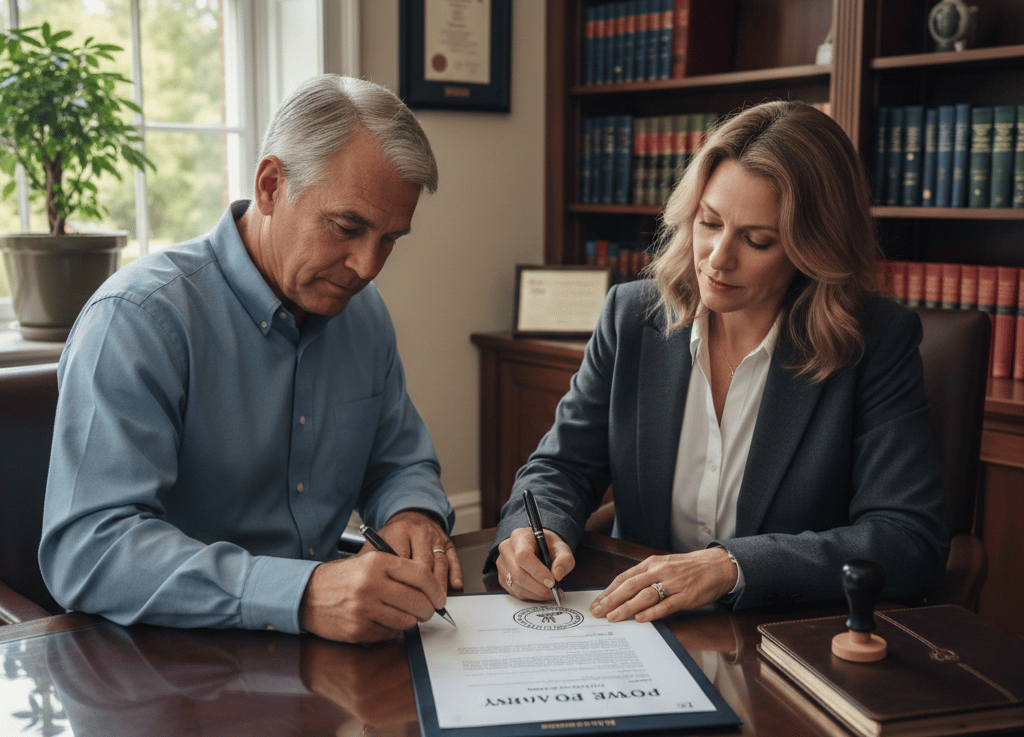
To notarize a Power of Attorney in Massachusetts, the principal must personally appear before the notary. The principal must present valid government-issued photo identification. The notary must confirm that the principal understands the document and is signing voluntarily.
The principal signs the document in the notary’s presence or acknowledges the signature. The notary completes the notarial certificate, applies their official stamp, and signs in accordance with Massachusetts requirements.
If the principal does not speak English, the notary must be able to communicate directly with the principal to confirm understanding.
What You Should Do Before Notarizing a Power of Attorney
Before notarizing a Power of Attorney, confirm how the document will be used and what the receiving institution requires. If the Power of Attorney involves real estate, notarization is required.
Make sure the document is complete before the appointment. Bring valid identification and ensure the principal is present and competent to sign.
Using an experienced Massachusetts notary, especially for Powers of Attorney, helps ensure the document is executed correctly and accepted when it matters most.
Disclaimer:
Middlesex Notary and its representatives are not attorneys and are not licensed to practice law in the Commonwealth of Massachusetts or any other jurisdiction. We do not provide legal advice, interpret documents, or assist in completing legal forms beyond the duties permitted by Massachusetts notary law. If you require legal guidance, document preparation, or advice regarding the content or effect of a document, please consult with a qualified attorney. All notarial acts performed by Middlesex Notary are limited to verifying the identity of signers, witnessing signatures, and completing authorized notarial certificates in accordance with Massachusetts General Laws, Chapter 222.
© 2026 Middlesex Notary. All rights reserved. Unauthorized use or reproduction of this content is strictly prohibited.
Document mailing address
335 Washington St #1127 Woburn, MA 01801 United States
Middlesex Notary Co provides trusted mobile notary services, apostille certification, printing and certified mailing, and faxing services across Middlesex County and Greater Boston. Whether you’re searching for a notary near me, need documents notarized fast, or want assistance with Massachusetts apostille processing, we deliver professional support right to your door.
Learn more about our services:
Mobile Notary | Apostille | Printing & Mailing | Faxing | Contact Us
Office location
500 W Cummings Park #4500, Woburn, MA 01801, United States