Massachusetts Notary Solutions for Middlesex & Greater Boston Areas

Do Affidavits Require a Notary Public?
Learn whether affidavits require a notary public in Massachusetts, why notarization is needed, common misconceptions, legal rules, and how to notarize an affidavit correctly.
12/16/20253 min read

Do Affidavits Require a Notary Public?
Yes, affidavits almost always require a Notary Public in Massachusetts. An affidavit is a sworn written statement made under penalties of perjury. Because it is a sworn statement, it must be signed in front of a notary who administers an oath or affirmation. Without notarization, an affidavit is generally not legally valid or accepted.
People ask this question because affidavits often look simple. Many are only one or two pages and appear similar to regular statements or letters. This creates uncertainty as to whether notarization is truly necessary or merely a formality.
What an Affidavit Is Under Massachusetts Law
An affidavit is not just a signed document. It is a sworn declaration that the contents are accurate to the best of the signer’s knowledge. In Massachusetts, affidavits are used in court proceedings, RMV matters, housing disputes, immigration cases, financial disputes, and many other legal contexts.
Because affidavits are relied upon as evidence, the law requires a formal process to confirm who made the statement and that it was made voluntarily and truthfully. This is where notarization becomes mandatory.
Why Affidavits Require Notarization
Notarization serves three legal purposes for affidavits. First, it verifies the identity of the person making the statement. Second, it confirms that the signer understands what they are swearing to. Third, it establishes that the statement was made willingly under oath or affirmation.
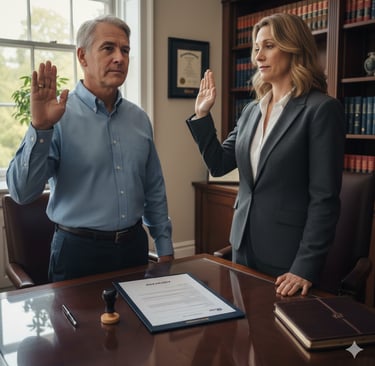
In Massachusetts, a notary must administer an oath or affirmation for an affidavit. This is called a jurat. The jurat confirms that the signer personally appeared before the notary, swore or affirmed the truthfulness of the statement, and signed the document in the notary’s presence.
Without this jurat, the document is not a proper affidavit. It becomes an unsworn statement, which many courts and agencies will reject.
Common Misconceptions About Affidavit Notarization
One common misconception is that signing an affidavit alone is enough. This is incorrect. A signature without an oath does not meet affidavit requirements.
Another misconception is that a notary reviews or verifies the facts in the affidavit. A notary does not investigate the truth of the statements. The responsibility for accuracy belongs entirely to the signer.
Some people also believe affidavits can be notarized later after being signed. In Massachusetts, the signer must sign in the notary’s presence or acknowledge the signature while present and still swear or affirm the contents.
How an Affidavit Is Properly Notarized
To notarize an affidavit in Massachusetts, the signer must personally appear before the notary. The signer must present valid government-issued photo identification. The notary must confirm that the signer appears competent and willing.
The notary then administers an oath or affirmation. This step is essential. After the oath, the signer signs the affidavit in the notary’s presence. The notary completes the jurat, signs it, and affixes their official stamp.
If the affidavit is incomplete or contains blank spaces, the notary must refuse to notarize until it is completed. Changes cannot be made after notarization.
Special Situations With Affidavits
If the signer does not speak English, the notary must be able to communicate directly with the signer. If communication is not possible, the notarization must be refused.
If the affidavit will be used outside the United States, it may require an apostille after notarization. This does not replace notarization; it follows it.
Remote notarization may be allowed in certain circumstances if the Massachusetts remote notarization requirements are met.
What You Should Do Before Notarizing an Affidavit
Before seeing a notary, complete the affidavit fully and review it carefully. Bring valid identification and ensure all signers are present.
Do not expect the notary to explain or edit the affidavit. If you have questions about what the affidavit should say, contact the requesting agency or an attorney.
Retaining an experienced Massachusetts notary ensures that the affidavit is notarized correctly and accepted without delay or rejection.
Disclaimer:
Middlesex Notary and its representatives are not attorneys and are not licensed to practice law in the Commonwealth of Massachusetts or any other jurisdiction. We do not provide legal advice, interpret documents, or assist in completing legal forms beyond the duties permitted by Massachusetts notary law. If you require legal guidance, document preparation, or advice regarding the content or effect of a document, please consult with a qualified attorney. All notarial acts performed by Middlesex Notary are limited to verifying the identity of signers, witnessing signatures, and completing authorized notarial certificates in accordance with Massachusetts General Laws, Chapter 222.
© 2026 Middlesex Notary. All rights reserved. Unauthorized use or reproduction of this content is strictly prohibited.
Document mailing address
335 Washington St #1127 Woburn, MA 01801 United States
Middlesex Notary Co provides trusted mobile notary services, apostille certification, printing and certified mailing, and faxing services across Middlesex County and Greater Boston. Whether you’re searching for a notary near me, need documents notarized fast, or want assistance with Massachusetts apostille processing, we deliver professional support right to your door.
Learn more about our services:
Mobile Notary | Apostille | Printing & Mailing | Faxing | Contact Us
Office location
500 W Cummings Park #4500, Woburn, MA 01801, United States