Massachusetts Notary Solutions for Middlesex & Greater Boston Areas

Deed of Trust Notarization in Massachusetts | Trustee Questions Answered
Learn whether a deed of trust must be notarized, who can notarize a deed transfer, what a trustee means, and when trustee acceptance requires notarization in MA.
1/26/2026
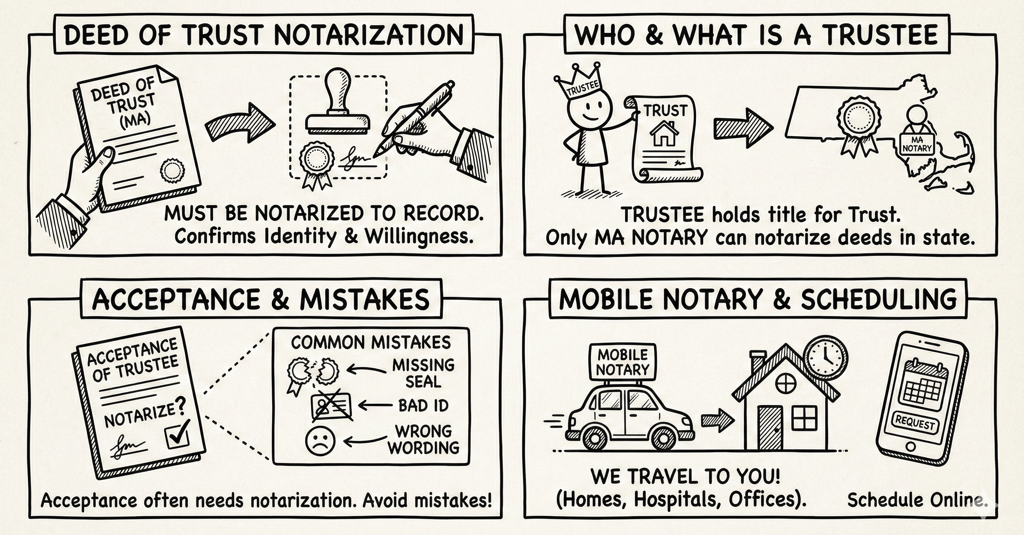
Deed of Trust Notarization in Massachusetts
Common Questions Explained Clearly
Property documents cause confusion because small mistakes can delay recording or invalidate a transfer. Deeds of trust and trustee-related documents are especially sensitive in Massachusetts, where notarization requirements must be followed precisely.
Below are clear answers to the most common questions property owners, trustees, and families ask.
Does a Deed of Trust Require Notarization?
Yes.
In Massachusetts, a deed of trust must be notarized to be valid for recording.
The grantor’s signature on the deed must be acknowledged before a Massachusetts notary public. Without notarization, the registry of deeds will reject the document, and the transfer or security interest will not be properly recorded.
Notarization confirms the signer’s identity and willingness to sign. It does not verify ownership or legal validity of the document itself.
If the deed will later be apostilled or used outside the state, proper notarization becomes even more critical.
Related service:
Mobile Notary Services in Middlesex County
Who Can Notarize a Deed Transfer?
Only a commissioned Massachusetts notary public may notarize a deed transfer signed in Massachusetts.
This includes:
In-office notaries
Mobile notaries who travel to the signer
Notaries performing hospital or nursing facility visits
The notary must:
Physically witness the signature
Verify acceptable identification
Complete a proper acknowledgment
Apply their official seal
Attorneys may notarize only if they also hold an active notary commission.
Related service:
Same Day Notary Services
What Does Trustee Mean on a Property Deed?
A trustee is a person or entity holding legal title to property on behalf of a trust, not for personal ownership.
In a property deed:
The trustee signs in their official trustee capacity
The trust name is listed as the owning entity
The trustee must have authority under the trust document
Trustees do not automatically have unlimited power. Registries often require proof of trustee authority, such as a trustee certificate or acceptance of trusteeship.
Incorrect trustee execution is a common reason deeds are rejected.
Related service:
Real Estate and Property Notarization
Does an Acceptance of Trustee Need to Be Notarized?
Often, yes.
An acceptance of a trustee is commonly notarized to:
Prove the trustee formally accepted the role
Satisfy registry or title company requirements
Establish authority for signing deeds and affidavits
While Massachusetts law does not mandate notarization in every scenario, most registries, attorneys, and title companies require notarization to avoid challenges or delays.
When in doubt, notarizing the acceptance is the safest option.
Related service:
Mobile Notary for Legal Documents
Common Mistakes That Delay Deed Recording
Missing notarization
Improper acknowledgment wording
Trustee signing without capacity listed
Expired or invalid identification
Signing outside the notary’s presence
Professional notarization helps prevent costly rejections.
Ready to Move Forward With a Deed or Trustee Document?
If you are preparing a deed of trust, trustee acceptance, or property transfer document, proper notarization is a critical final step. Mobile notarization allows documents to be completed correctly at your location, including homes, offices, hospitals, and care facilities.
Visit the contact page to request availability and scheduling:
https://middlesexnotary.com/
Disclaimer:
Middlesex Notary and its representatives are not attorneys and are not licensed to practice law in the Commonwealth of Massachusetts or any other jurisdiction. We do not provide legal advice, interpret documents, or assist in completing legal forms beyond the duties permitted by Massachusetts notary law. If you require legal guidance, document preparation, or advice regarding the content or effect of a document, please consult with a qualified attorney. All notarial acts performed by Middlesex Notary are limited to verifying the identity of signers, witnessing signatures, and completing authorized notarial certificates in accordance with Massachusetts General Laws, Chapter 222.
© 2026 Middlesex Notary. All rights reserved. Unauthorized use or reproduction of this content is strictly prohibited.
Document mailing address
335 Washington St #1127 Woburn, MA 01801 United States
Middlesex Notary Co provides trusted mobile notary services, apostille certification, printing and certified mailing, and faxing services across Middlesex County and Greater Boston. Whether you’re searching for a notary near me, need documents notarized fast, or want assistance with Massachusetts apostille processing, we deliver professional support right to your door.
Learn more about our services:
Mobile Notary | Apostille | Printing & Mailing | Faxing | Contact Us
Office location
500 W Cummings Park #4500, Woburn, MA 01801, United States